

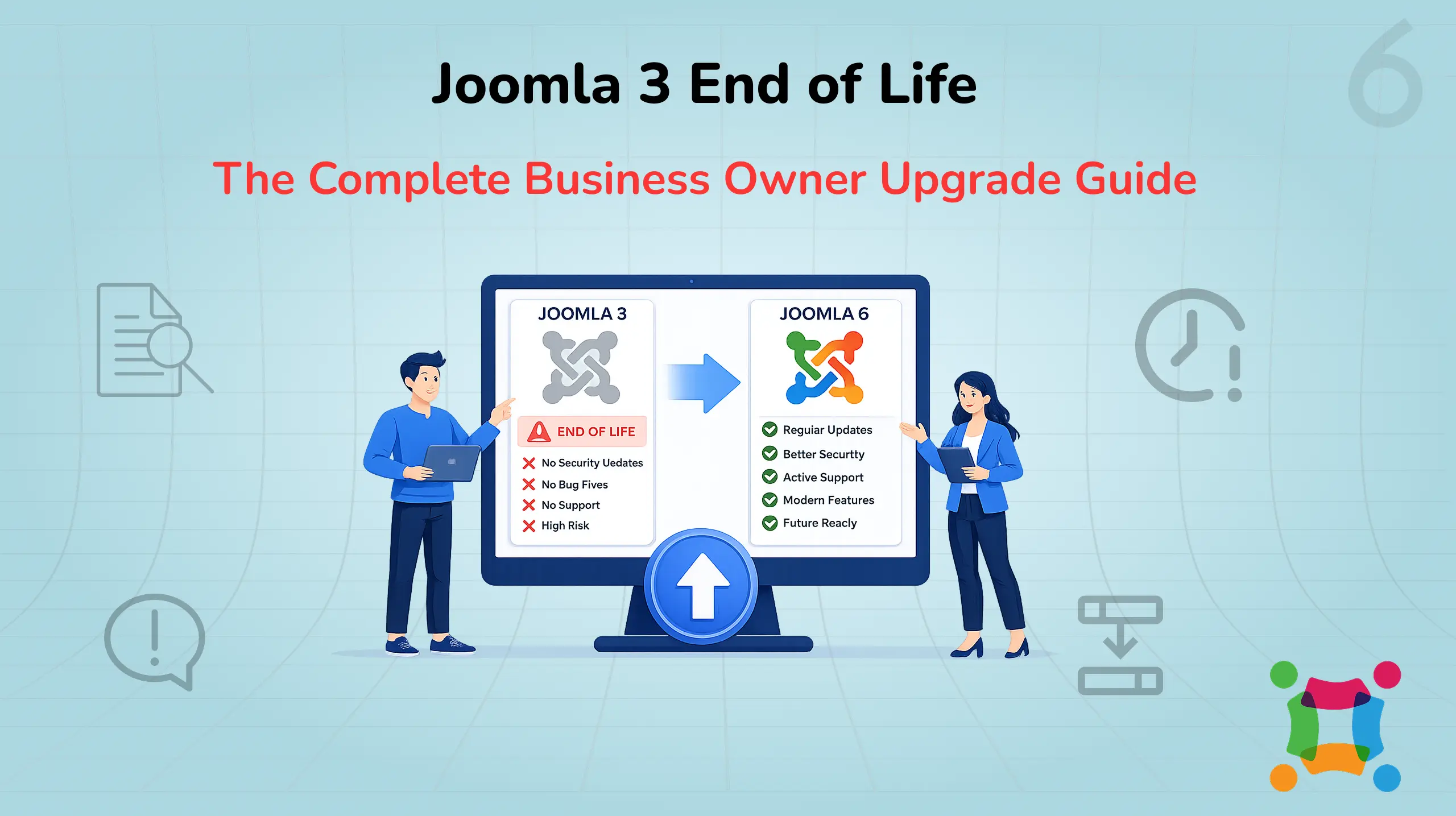
Importantly, Joomla 3 officially reached end of life on 17 August 2023. Furthermore, all security patches stopped in February 2025. If your website still runs on Joomla 3, it is currently operating without any security support — making it a live target for hackers. As a result, this guide explains exactly what end of life means, what risks your business faces right now, and how to upgrade safely to a supported version.
What Does Joomla 3 End of Life Actually Mean?
In short, end of life (EOL) means the Joomla development team has officially stopped releasing updates, bug fixes, and — most critically — security patches for Joomla 3. In other words, the official Joomla team will never patch any new security vulnerability discovered in Joomla 3.
Your Site Does Not Stop Working — But It Stops Being Safe
Indeed, many business owners assume that end of life means their website will go offline. That is not the case, however. However, what does happen is that your site continues running on software that is no longer protected. As a result, every day that passes without security updates gives hackers a greater chance to compromise your site.
Specifically, hackers actively target known vulnerabilities in end-of-life software because they know patches will never come. As a result, Joomla 3 sites are considerably more attractive targets in 2026 than they were before the EOL date.
🚨 Important dates to know: Joomla 3 reached end of life on 17 August 2023. All extended security support (eLTS) patches ended in February 2025. As of today, there are no more security updates of any kind for Joomla 3.
Secure Your Joomla Site Before It’s Too Late
If your website is still on Joomla 3 or Joomla 4, we can help you migrate safely to Joomla 5 or Joomla 6 — without losing your design, content, or SEO rankings. We have completed 50+ Joomla upgrades for businesses worldwide. Book your free audit today.

The Complete Joomla 3 Support Timeline
Understanding the timeline helps put the current situation into context. Joomla 3 had a remarkably long life — over a decade of service — which is why so many business websites still run on it today.
September 2012
Joomla 3.0 released. It introduced a new responsive admin interface and improved accessibility. Subsequently, it became one of the most widely adopted CMS versions ever released.
August 2021
Joomla 3.10 released — the final minor version of Joomla 3. Specifically, this release served as a bridge to help sites transition safely to Joomla 4.
17 August 2023
Joomla 3 officially reached end of life. As a result, bug fixes and regular security updates stopped. However, extended security support (eLTS) was still made available as a paid option for €90 per site.
February 2025
All security patches ended — including the paid eLTS programme. Consequently, from this point onwards, no security updates are available from any official source. In other words, every Joomla 3 site is now fully exposed.
April 2026 — Today
Joomla 3 is fully unsupported.In fact, any site still running Joomla 3 has gone more than 14 months without security updates. Furthermore, Joomla 6.1 is now the current version — making Joomla 3 three major versions behind.
The Real Risks of Running Joomla 3 in 2026
Staying on Joomla 3 is not simply a technical inconvenience, however. Instead, it creates four specific categories of real business risk that every site owner should understand.
Joomla 3 vs Joomla 5 vs Joomla 6 — What Changed?
To understand why upgrading is worthwhile beyond just security, it helps to see specifically what has improved since Joomla 3.
| Feature | Joomla 3 | Joomla 5 | Joomla 6 |
|---|---|---|---|
| Security support | ❌ None since Feb 2025 | ✅ Until Oct 2027 | ✅ Active |
| PHP compatibility | PHP 7.x only | PHP 8.1 – 8.5 | PHP 8.3 – 8.5 |
| Admin interface | Outdated Isis template | Modern Atum with CSS transitions | Modern Atum with CSS transitions |
| Content workflows | Not available | Available | Visual drag-and-drop editor |
| Custom fields | Basic | Extended | Audio, video, documents added |
| Automatic updates | Not available | Available from 5.4 | Available |
| Performance | Legacy codebase | Modernised PHP framework | PHP 8.5 + language caching |
| Spam protection | Requires third-party | Requires third-party | Built-in invisible CAPTCHA |
The Upgrade Path: From Joomla 3 to Joomla 6
One of the most common questions business owners ask is whether they can jump directly from Joomla 3 to Joomla 6. Unfortunately, a direct upgrade is not supported at all. Instead, the official path goes through multiple stages.
The Required Upgrade Path
Joomla 3 → Joomla 3.10 → Joomla 4.4 → Joomla 5.4 → Joomla 6
Each stage requires its own backup, extension compatibility check, and testing in a staging environment. However, a professional developer can handle the entire multi-stage path on your behalf — you do not need to manage each step manually.
Which Version Should You Target?
If you are upgrading from Joomla 3 today, most businesses should therefore target either Joomla 5.4 or Joomla 6. Specifically:
- Joomla 5.4 — the Long-Term Support (LTS) version, supported with security patches until October 2027. This is the safer choice if some of your extensions are not yet confirmed compatible with Joomla 6.
- Joomla 6 — the latest major version with all new features. This is the better long-term choice if your extensions are Joomla 6 compatible and you want access to the newest capabilities.
How Long Does a Joomla 3 Upgrade Take?
The timeline varies considerably, depending on the size and complexity of your site. Based on real-world project data, here are realistic estimates for a Joomla 3 to Joomla 5 or 6 upgrade:
| Site Type | Typical Timeline | Main Factors |
|---|---|---|
| Simple brochure site 5–10 pages, few extensions, default template | 3 – 7 days | Extension compatibility, template update |
| Standard business site 10–30 pages, standard extensions, custom template | 1 – 3 weeks | Template rebuild, extension audit, testing |
| Complex site with custom extensions Custom components, integrations, large content base | 3 – 6 weeks | Custom code rewriting, extensive testing |
| Large e-commerce or membership site VirtueMart, HikaShop, complex user management | 4 – 8 weeks | Data migration, payment gateway testing, user data |
Step-by-Step: How the Upgrade Process Works
Whether you are handling the upgrade yourself or working with a developer, understanding the process helps you plan effectively and avoid surprises.
01. Full Backup of Files and Database
Before anything else, a complete backup of all website files and the database is essential. This creates a restoration point if anything goes wrong during the upgrade. Furthermore, the backup should be stored in a separate location — not just on the same server as your website.
02. Extension and Template Audit
You must check every extension and template on your site for Joomla 5 or 6 compatibility. Specifically, log into the Joomla Extensions Directory (JED) and filter by version to see which of your extensions have compatible versions available. Therefore, you will need to replace any extensions with no update path.
03. Set Up a Staging Environment
A staging environment is a private copy of your website where the upgrade is performed and tested. Consequently, your live site remains online and unaffected while all upgrade work happens in the staging environment. Never perform a major Joomla upgrade directly on a live production site.
04. Multi-Stage Upgrade (3 → 3.10 → 4.4 → 5.4 → 6)
The upgrade happens in stages. First, ensure you are on Joomla 3.10.x. Then upgrade to Joomla 4.4, followed by Joomla 5.4, and finally to Joomla 6 if desired. Specifically, each stage requires its own testing pass before proceeding to the next.
05. Full Functionality Testing
After each upgrade stage, test all key functionality — forms, contact pages, e-commerce flows, user login, and any custom components. In addition, test the site on both desktop and mobile browsers before going live.
06. Go Live and Post-Launch Monitoring
Once all testing is complete and the upgraded site performs correctly on staging, your developer pushes it to the live server. Subsequently, monitor the site for 24–48 hours after go-live to catch any environment-specific issues that did not appear in staging.
Frequently Asked Questions
No — your site will not go offline because of end of life, however. However, it will become increasingly vulnerable to security attacks and compatibility issues over time. Moreover, hosting providers upgrading their PHP versions may break Joomla 3 sites that depend on older PHP 7.x versions.
Unfortunately, a direct jump is not supported. Instead, the upgrade must go through Joomla 3.10, then Joomla 4.4, then Joomla 5.4, and finally to Joomla 6 if desired. Fortunately, a professional developer handles this multi-stage path on your behalf so you do not need to manage each step yourself.
The upgrade process preserves all your articles, pages, images, and user data throughout. In fact, the upgrade path is specifically designed to keep your content intact. Nevertheless, a full backup before starting is always essential as an additional safeguard.
Not necessarily. However, if your current Joomla 3 template does not have a Joomla 5 or 6 compatible version, you will need to rebuild the template. In many cases, this also gives you an excellent opportunity to refresh your site’s design — particularly valuable if your site has not had a visual update in several years.
The cost depends on your site complexity, the number of extensions, and whether you need a template rebuild. A simple upgrade typically starts from a few hundred dollars. More complex sites with custom extensions or e-commerce can cost more. In all cases, however, a planned upgrade is significantly cheaper than emergency recovery after a security breach.
 Still Running Joomla 3? Let’s Fix That.
JoomConsultant has completed 50+ Joomla 3 upgrades for businesses worldwide — including complex migrations involving VirtueMart, custom components, and multilingual setups. Get a free assessment of your site today.
to discuss your Joomla project and discover how we can build a powerful website tailored to your business needs.
Final Thoughts
If your site still runs on Joomla 3, the right time to upgrade was 2023. Nevertheless, the next best time is right now. Furthermore, the longer you wait, the greater the security risk — and the more likely it becomes that a hosting PHP upgrade or hacking incident forces an expensive emergency response.
In fact, a professional assessment of your current site takes less than an hour and covers exactly what the project requires, how long it will take, and what it will cost. This gives you a clear plan to move forward confidently.


